
- Winter 2024: E3B MA student Adrian Casanova and I traveled to Madre de Dios (Peruvian Amazon) to jumpstrat two projects: evaluation of the ecotourism industry sustainability in Tambopata National Reserve, and deploying camera traps for biodiversity assessment on the LXG Amazon Reforestry Fund ranch near Inapari.

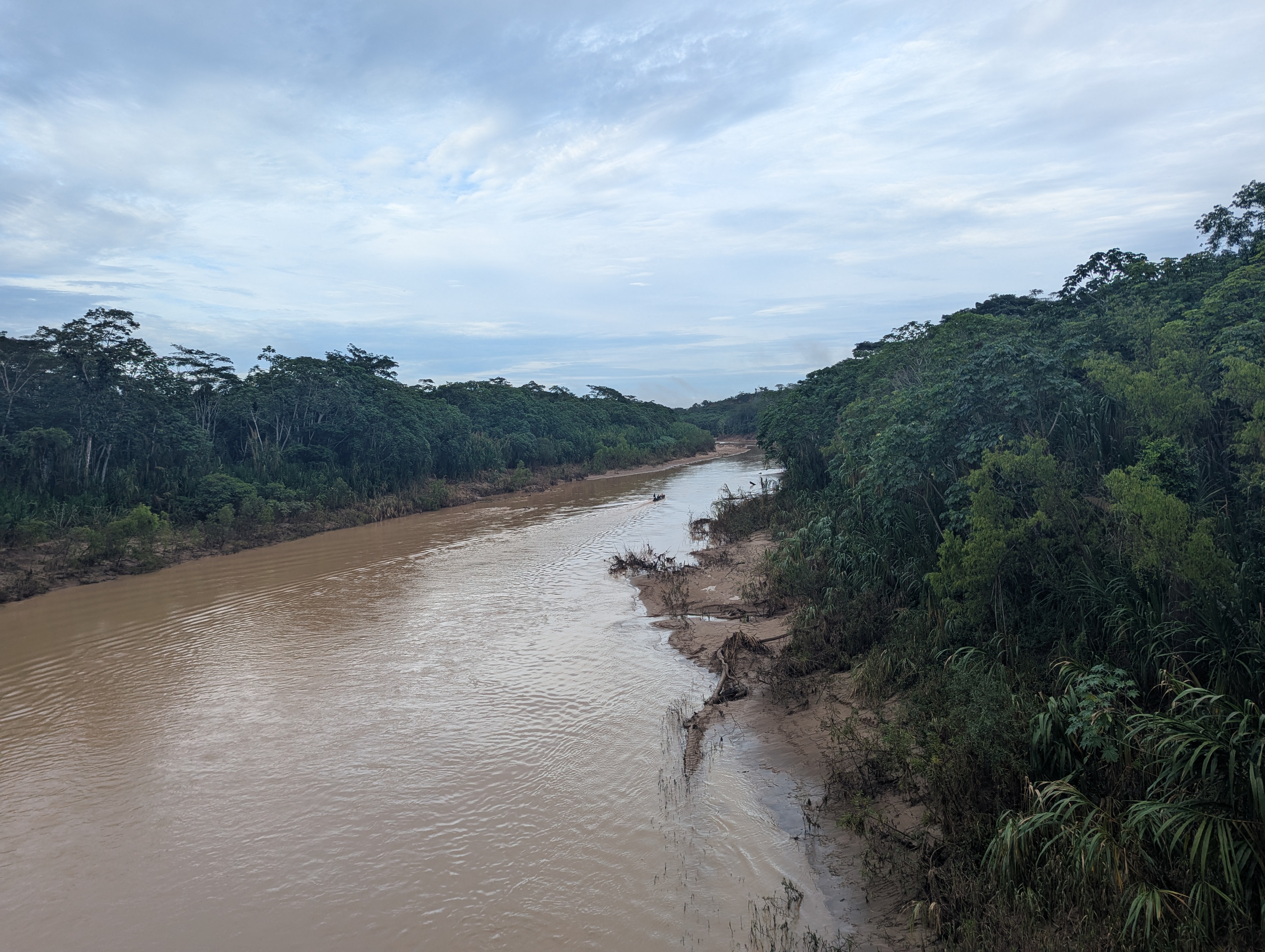

- Fall 2024: Our lab is welcoming 3 new Columbia E3B MA students! Arel Triyono (hellbender ecology; pic below), Adrian Casanova (ecotourism and land use change in the Amazon) and Hannah Hess (vertebrate community interactions in the Romanian Carpathians) have started their Columbia journey in the classroom, the field and through strong NSF-GRFP proposals!
We are also going to the 2024 TWS (The Wildlife Society) Annual Conference in Baltimore! Second-year E3B MA students Dani Pergola, Henry Hardy and Jared Kannel ar epresenting poster on hellbender density estimation, interspecific relations between bobcats and coyotes, and fine scale habitat seelction in translocated European bison, respectively! Dani and Jared also presented their work at the American Museum of Natural History Student Conference on Conservation Science.

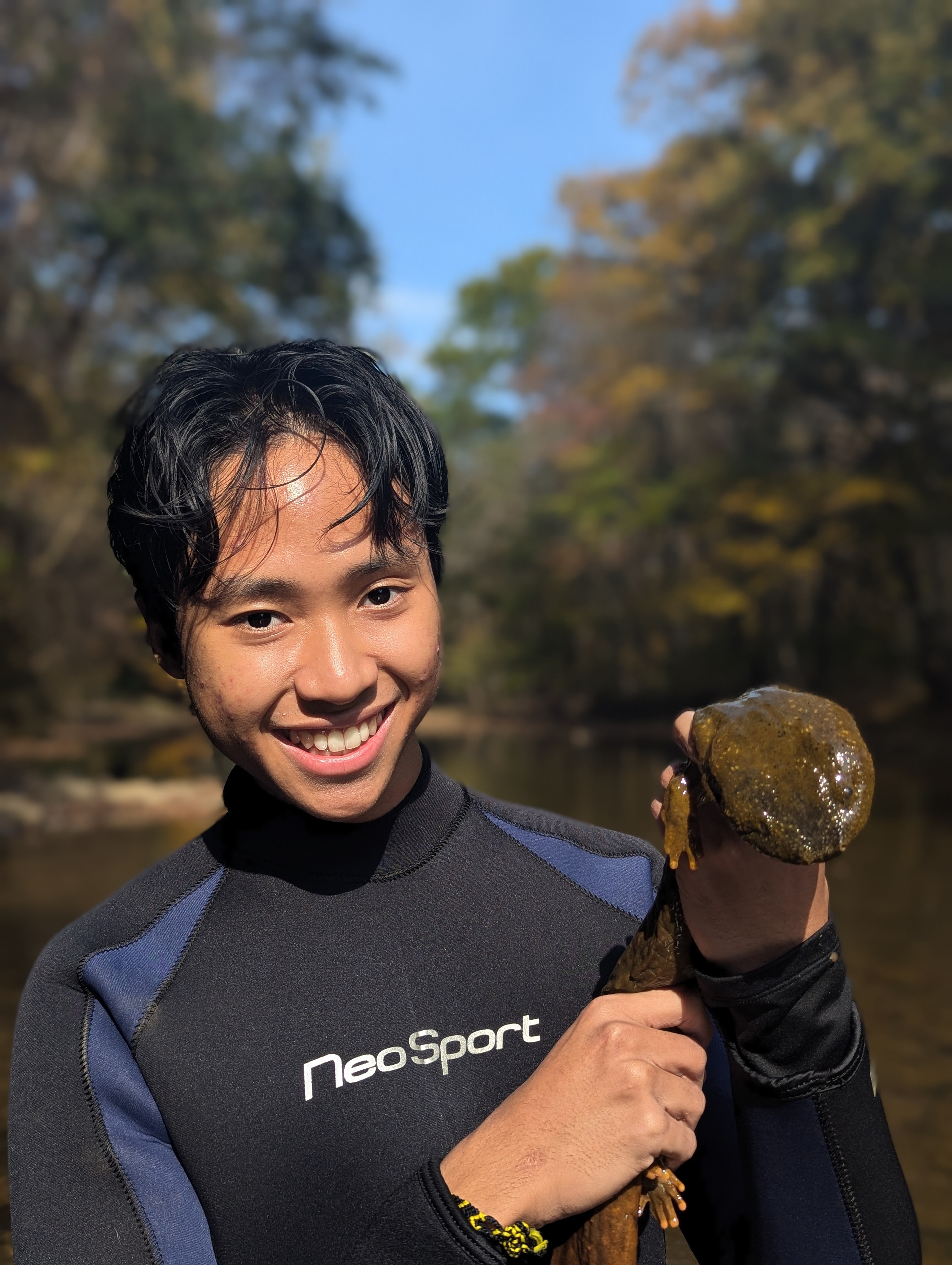
- Summer 2024: Congratulations to Lucy Holland, our lab’s first @Columbia fledgling and new E3B MA graduate! Her work on space use and habitat selection in translocated European Bison in the Romanian Carpathians took her on a journey to Brasov, Romania to work with colleagues from Conservation Carpathia, to Bologna, Italy to present a poster at the 2024 European Congress of Conservation Biology and lately to hometown London where she works on a insect conservation project with researchers from the University College London.
- Spring 2024: Two former undegraduate students in my former Ohio University lab published their Honors theses as first authors! Andrew Connolly work on 14-year trends in anuran occupancy in Ohio’s Buckeye (formerly Wayne) National Forest was published in HerpConBio, and Madeline Kenyon’s modeling paper on American beaver trends in abundance informing aerieal monitoring efforts was just accepted in Wildlife Research. Congrats to both hard working and brilliant students for their first first-authored publications!
We published a new paper with colleagues from the University of Bucharest (Laurentiu Rozylowicz, Raluca Bancila and collabs) in Global Ecology and Conservation on trends and patterns in the occupancy modeling literature. After reviewing 700 papers between 2002 and 2022, we found that the field is advancing fast (methodologically) but trends follow other ecology fields: most papers are focused on US and other Western countries and authorship and collaboration networks come from the same locations. High biodiversity regions are under-represented despite the fact that occupancy models are suited for low-effort, rapid collection data (camera trap, visual surveys, eDNA, etc.) which are being implemented in such regions. - Fall 2023: In other exciting news, the lab’s first Eastern Hellbender paper has been published open-access in journal Population Ecology (paper here). The work was led by PhD student Matt Kaunert (now Director of the Clean Water Institute at Lycoming College, PA) and involved collaborators from USGS, Columbus Zoo and the Ohio Hellbender Partnership and funding from the Ohio Division of Wildlife. This paper is the culmination of 4 years of PIT-tag surveys to evaluate the survival of headstart hellebdners released in Ohio streams; we found that while survival was low (0.16 across 4 years), headstarting is a good conservation strategy for rebuilding populaitons, and that successive releases at suitable sites are needed to rebuild populations. Read our press release here.

- Fall 2023: Dr. Marissa Dyck’s Spatial PVA paper for Ohio’s bobcat population is out in The Journal of Wildlife Management (access open-access paper here). Thank you Dr. Shoemaker (Applied Population Lab at Univ of Nevada, Reno) for your sharing your PVA and coding prowess and Catherine Dennison (furbearer biologist at Ohio Division of Wildlife) for ensuring that the research is rooted in on-the-ground reality! We found that the Ohio bobcat population is expanding and can support a limited harvest season, but only if road mortality is accounted for (these cats are not great at crossing roads (and staying alive), as shown by former lab member Heidi Bencin (MSc 2018, Ohio University)).
- Summer 2023: Our lab has moved to Columbia University E3B in New York City (from Ohio University, Athens)
Columbia E3B MA student Lucy Holland traveled to Romania to work with colleagues at Foundation Conservation Carpathia on spatial ecology of translocated European Bison! Exciting times chasing bison, visiting Dracula-land, but also data munging and dealing with a heap of GPS collar data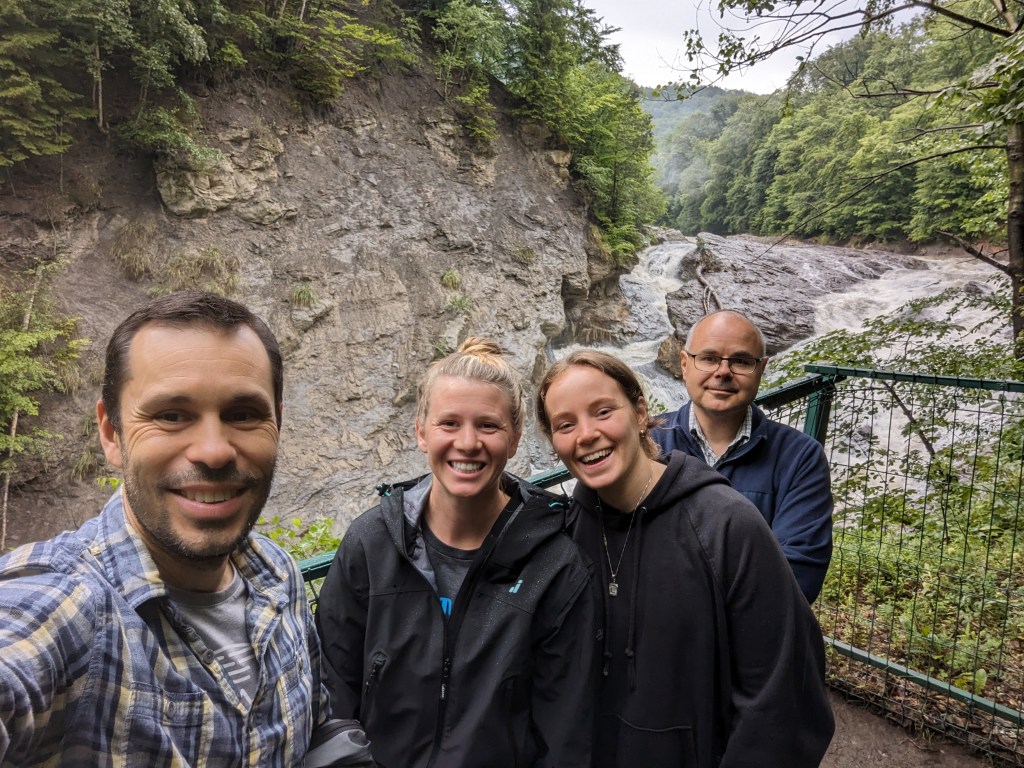 (left to right) Viorel Popescu, Marissa Dyck, Lucy Holland and Laurentiu Rozylowicz… at Putna Falls, Lepsa, Vrancea
Newly-minted Dr. Marissa Dyck also traveled to Romania this Summer to deliver an R workshop to 25 colleagues from Romanian NGO, management agencies and academia. We topped that with an occupancy workshop held by my colleagues Dr. Raluca Bancila, Dr. Laurentiu Rozylowicz and myself… all in a great setting at Casa Tisaru in Lepsa, Vrancea.
Congratulations to Dr. Marissa Dyck (@Dyck_ologist) for wrapping up and successfully defending her dissertation on carnivore ecology in Romania and Ohio. With 3 chapters published (see Publications) and a couple more on the way, Marissa delved into advanced stats and modeling to evaluate the population viability and density of bobcats in Ohio, interspecific interactions between mesocarnivores and between top predators and mesocarnivores, as well as processes mediating predator-prey interactions in a Romanian large mammal guild. - Summer 2022 was a big Summer for our lab!!! In addition to lots of papers featuring graduate and undergraduate authors, a lot of exciting developments…
Congratulations to newly-minted Dr. Cassandra Thompson (@Hotherps) for successfully defending her dissertation on amphibians and climate change in July! With 3 chapters already published and another 2 on the way, Cassie has started a postdoc in amphibian ecology and modeling at Case Western Research University (with collaborator Dr. Mike Benard).
Huge congrats to Ryan Brown, who defended his MSc thesis on Eastern Hellbender ecology in August!!! Keep an eye for upcoming papers on experimental research debunking some long-standing ‘myths’ in hellbender ecology!
PhD student Marissa Dyck won the highest graduate student award from the American Society of Mammalogists (the ASM Fellowship) for her work on interspecific interactions between terrestrial carnivores in North America and Europe.
PhD student Matt Kaunert is starring as the hellbender scientist in an upcoming documentary around the fight (and victory!) of a small Pennsylvania community against the fossil fuel industry. HELLBENT (@hellbenderfilm) was created by Justin Grubb (Running Wild Media) and freelance journalist Annie Roth and is out August 2022. - Spring 2022: After a 2-year process, the fruits of a collaboration with colleagues at Harvard University, University of East Anglia, the Chinese Academy of Sciences and TNC China are ripe! Check our new Nature Communications paper on using DNA from terrestrial leech meals (or iDNA) to monitor vertebrate biodiversity in SW China. This research also allowed us to evaluate the effectiveness of the protected areas for conserving vertebrate biodiversity. We found many IUCN-listed species (amphibians, reptiles, mammals, birds) in terrestrial leech meals; pioneering genomics and bioinformatics work (led by Dr. Doug Yu) and colleagues in China combined with Multi-Species Occupancy Models (led by Dr. Chris Baker) are a powerful combination for rapid biodiversity surveys!
Ji, Y., Baker, C.C.M., Popescu, V.D. et al. Measuring protected-area effectiveness using vertebrate distributions from leech iDNA. Nat Commun 13, 1555 (2022). https://doi.org/10.1038/s41467-022-28778-8 - Summer 2021: New letter in Science hot off the press: Popescu, V. D., M. I. Pop, and L. Rozylowicz. 2021. Trophy hunting undermines public trust. Science 372:1049 LP – 1049. This perspective piece provides a critique of the current wildlife management in Romania, which is tolerant of trophy hunting for brown bears despite the species protected by EU legislation and payment for trophies being banned since 2016. Read more about the events that threw Romanian wildlife management in turmoil here.
- Winter-Spring 2021: Lots of exciting news!!! We started 2 camera trap projects in Ohio and Romania aimed at evaluating interspecific relations between terrestrial carnivores (keep an eye on Twitter updates!). Also, after 4 years of sustained work, “Fundamentals of Conservation Biology” 4th edition textbook (with mentors Mac Hunter [University of Maine] and James Gibbs [SUNY-Environmental Science and Forestry]) is finally out!!!
- Fall 2021: It’s all about carnivores in N America! First off, a great collaboration between PhD students Marissa Dyck and Eileen Wyza led to the first assessment of competitive interactions between bobcat and coyotes in North America (published in Mammal Review). Second, our paper on the #RealBobcatsofOhio habitat suitability and connectivity is out in PeerJ; this is a collaboration with Ohio Division of Wildlife and the Peterman Lab at Ohio State University. We added another piece of the puzzle that is bobcat recovery in Ohio!
- August 2020: We are welcoming Ryan Brown as a new MSc student in the lab! Ryan has been engaged with research in our lab since 2018, first as a undergraduate research assistant, then as a Lab Manager for the last year. Ryan obtained a degree from Hocking College prior to joining Ohio University, has a broad set of field skills, and is an encyclopedia of natural history knowledge. Ryan will work with Matt Kaunert exploring the lives and reproductive ecology of Eastern Hellbenders and contribute to proposing sound conservation strategies for hellbenders in Ohio and Pennsylvania.
November 2019 – Heidi Bencin’s MSc research on road mortality in Ohio’s bobcat population is out in Scientific Reports! Heidi’s study integrated roadkill data across two decades, a GPS telemetry dataset to evaluate road-crossing behaviors, and theoretical estimations of road mortality risk at the population level to ultimate valuate predictors and hotspots of roadkill. Interstate highways were the top threat with high chance of mortality during crossings, and overall, we estimated that 6 – 18% of Ohio’s bobcat population may be affected by direct mortality from vehicle strikes. This finding is critical for projecting future population trajectory, which is the next step in the Ohio DNR funded project in the lab.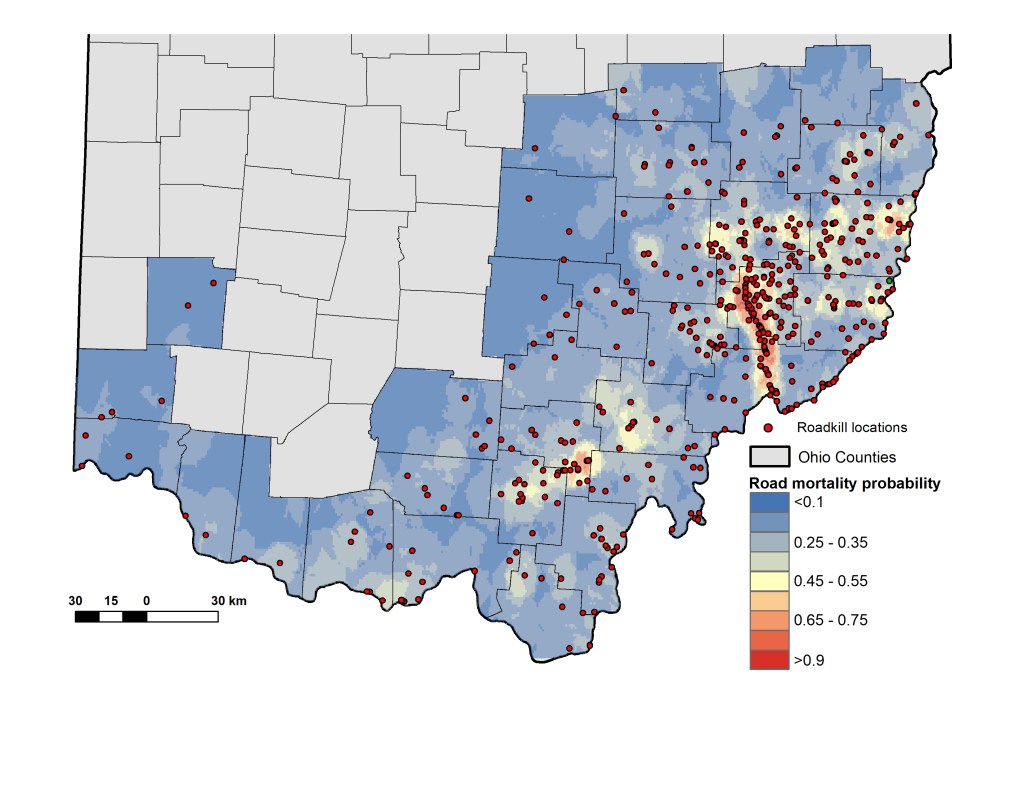
- September 2019 – Marcel Weigand’s MSc research in press at European Journal of Wildlife Management (Proximity to highways has limited influence on space use and physiology of terrestrial testudines)! Great collaboration with Dr. Chris Tonra and the Avian Ecology Lab at The Ohio State University. Highway Right-of-Way provided thermoregulating turtle habitat, there were no differences in habitat selection and home ranges between roadside turtles and turtles in a nearby roadless area. However, roadside turtles strongly avoided the highway; this is good news from a road mortality standpoint, bad news from a population connectivity standpoint. Stress hormone (corticosterone) concentrations were similar between Bypass and roadless site at the onset of the study, but they spiked a year later at the road site.

- Summer 2019 – Many exciting things going on in the lab! Courtney Silver will join the lab in the Fall as a PhD student; she comes from California State University, Chico, and is interested in amphibian ecology and conservation. We (Romanian colleagues and I) also published a Perspective in journal in Science (14 June issue) calling for transparent science and decision process around large carnivore conservation and management in Romania: Romanian carnivores at a crossroads. We have been providing scientific support to several NGO’s and wildlife management agencies on large carnivore research projects… busy time in Romania!
- January 2019 – Second collaboration with Dr. Bekka Brodie, and the first paper on invertebrates from our lab! We developed a non-lethal monitoring method using pheromone lures and occupancy methods to assess saproxylic beetle diversity and abundance, focused on a beautiful traditionally-maintained landscape in SW Romania. Read more in this post on the OHIO College of Arts and Sciences Forum.
November 2018 -Heidi Bencin is the second lab fledgling! CONGRATS Heidi for a fabulous MSc thesis and defense on bobcats, roads, camera trapping, genetics… and so on…! Thank you for the incredible amount of work and dedication… and your amazing drawings!
September 2018 – Our lab, supported by several other faculty in the Departments of Biological Sciences, Environmental and Plant Biology and the Voinovich School Environmental Studies Program, was awarded $50,000 from the Ohio University 1804 Fund to develop an outdoor aquatic mesocosm research facility on the OHIO Athens campus. This facility research will provide research and experiential learning opportunities for undergraduate and graduate students, and facilitate collaborations with a broad network of similar facilities in the US Midwest and Northeast. Find more details about the facility and ongoing aquatic mesocosm research involving larval amphibians at OHIO here.
August 2018 – PhD student Matt Kaunert, joined by with OHIO undergraduate researchers Andrew Travers, Ryan Wagner, Christine Hanson, and Megan Sweeney, Hocking College student Hannah Kopp, research assistant Julia Golias, and French graduate Student Eva Garcia, are helping out with Eastern Hellbender releases in Ohio (in collaboration with Ohio DNR; see photos below) and deployment of nest boxes, a habitat augmentation strategy, in Pennsylvania.


July 2018 – Marcel Weigand, Cassie Thompson and Heidi Bencin presented their MSc research at the North American Congress for Conservation Biology, Toronto. Cassie and Marcel were selected as Student Award Finalists, out of hundreds of abstract submissions! Congrats…. #OhioBobcats represent!

JULY 2018 – First thesis defense in my lab! Marcel Weigand did an incredible job showcasing her novel ecological and physiological research on impacts of roadways on Eastern Box Turtles. CONGRATULATIONS!
June 2018 – The lab’s first Ohio wildlife research paper published in the open-access journal Frontiers in Ecology and Evolution!
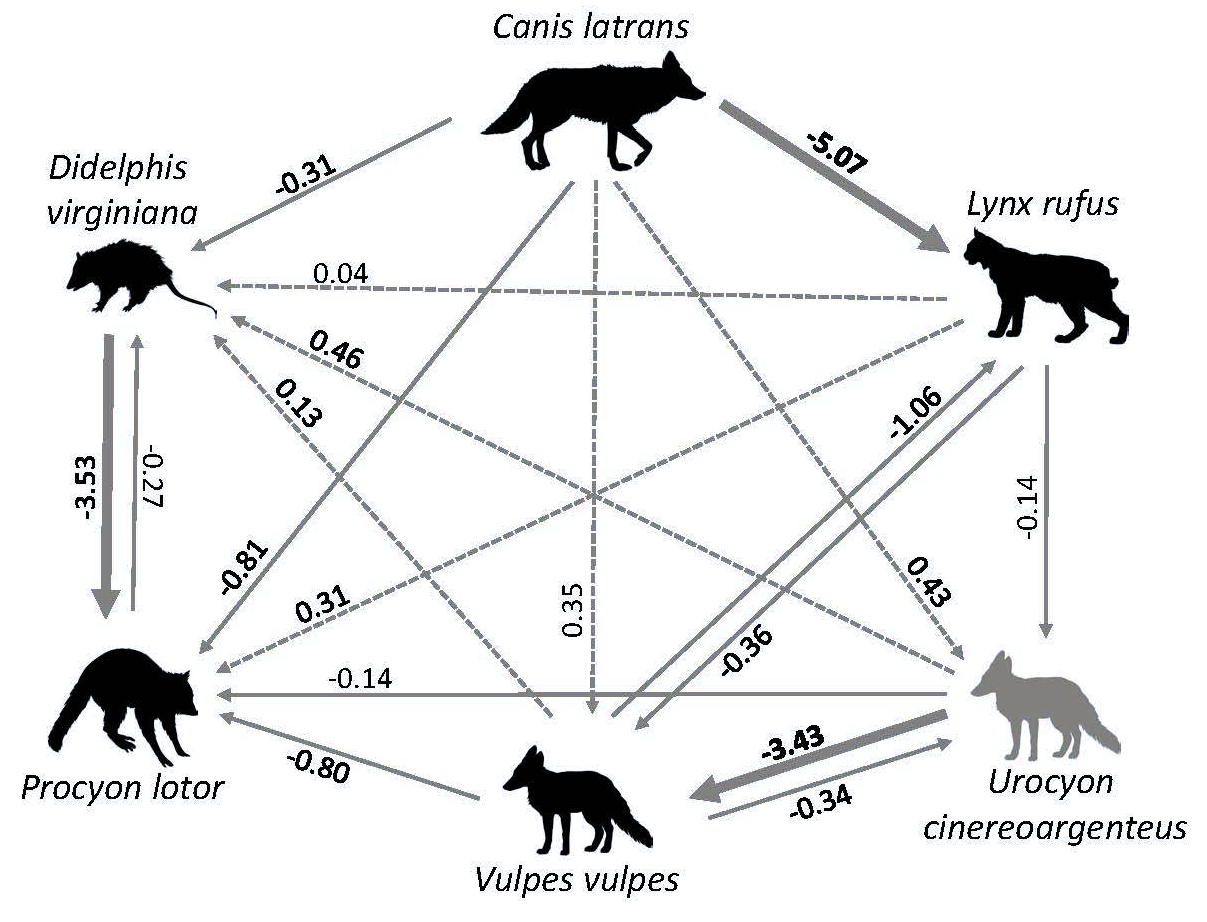
Rich, M., C. Thompson, S. Prange, and V.D. Popescu. Relative importance of habitat characteristics and interspecific interactions in determining terrestrial carnivore occurrence. This is our first field project in Ohio (2016) and was spearheaded by HTC and BIOS student Mackenzie Rich (now a MSc student at Wright State), and current graduate student Cassie Thompson; also a great collaboration first with Dr. Suzie Prange. We thank the Honors Tutorial College for funding Mackenzie to do this work. The study was featured on the OHIO CAS Forum.
April 2018 – A great month!!! Marissa Dyck accepted a PhD position on our lab working on bobcat ecology and will be joining us in the Fall; WELCOME! Cassie Thompson switched from MSc to a PhD position in the lab, so more frogs and climate change experimental work funded by NSF-Graduate Research Fellowship Program. Ohio DNR funded a 3-year project on Eastern Hellbender ecology and conservation; kudos to PhD student Matt Kaunert for all his work on developing this project, and thanks to collaborators Gregg Lipps, Steve Spear (The Wilds) and John Navarro (ODNR) for the support! New study on brown bear spatial ecology in Nature Conservation from PhD student Mihai Pop and collaborators at University of Bucharest.
April 2018 – Undergraduate student Ryan Brown (featured here with OHIO President Duane Nellis) won 1st place in the university-wide Student Expo competition. His poster on evaluating biases in citizen science data used for bobcat management in Ohio was absolutely amazing and all his hard work, both in the field and in the lab paid off. 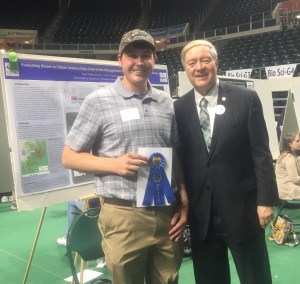
January 2018 – Seed grant money from the Ohio University Research Committee for Eastern Hellbender ecology! PhD student Matt Kaunert will be working closely with Ohio DNR to monitor captive-bred and released subadults using amplified PIT tag readers, and to understand reproductive ecology by monitoring nest boxes. Exciting project and a new species for our lab!
January 2018 – New paper in Animal Conservation on spatial conservation prioritization for Brown bears in Romania (with colleagues from University of Bucharest and Association for Biodiversity Conservation). We integrated space use information (home range, habitat selection) and systematic conservation planning (software Zonation) and identified connected, high conservation value habitats, which will inform current efforts to redraft the Romanian national management plan for brown bears!
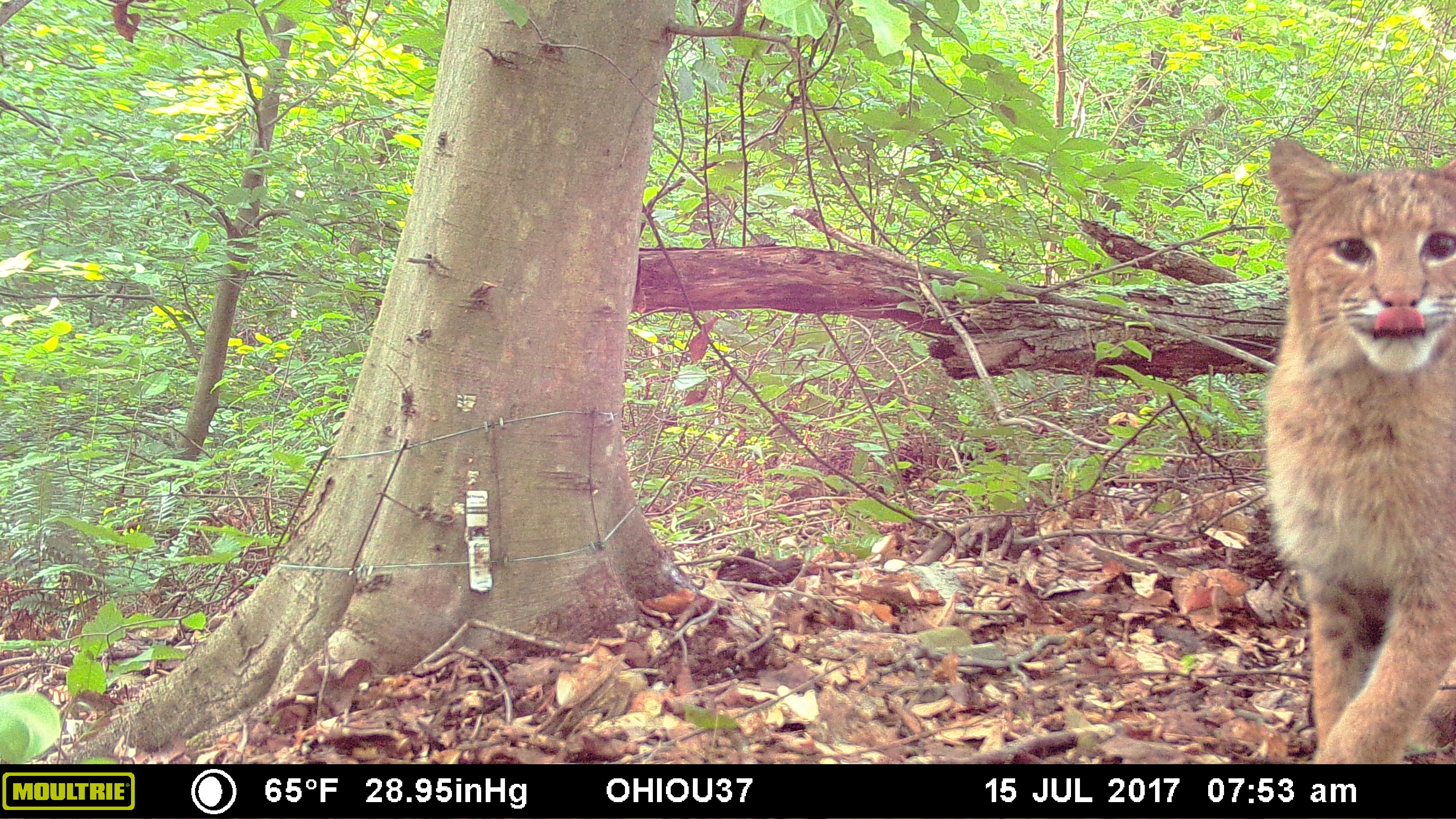
September 2017 – We received funding from the Ohio Department of Natural Resources to study bobcat ecology in Ohio! Looking forward to working with Ohio Division of Wildlife biologists over the next 4 years to develop a population model to understand the viability of Ohio’s recovering bobcat population, and inform bobcat management and conservation. Graduate student Heidi Bencin started preliminary work on occupancy and non-invasive genetics this Summer (2017).
August 2017: We are welcoming Matt Kaunert, the newest member of the Conservation Ecology lab at OhioU. Matt will pursue a PhD in Ecology and Evolutionary Biology focused on the ecology and behavior of the supercool Eastern Hellbender in Ohio.
August 2017: First lab fledgling!!! Mackenzie Rich defended her Honors thesis titled “Understanding the terrestrial carnivore community in SE Ohio”. CONGRATS! Mackenzie is doing an internship at The Wilds (Columbus Zoo) in central Ohio, and will start a Masters program at Wright State University in Fall 2018.
June 2017 – New paper on estimating brown bear abundance in the Romanian Carpathians using snow and mud track surveys is out in Ecology and Evolution! With colleagues from Vrancea EPA (http://lifeursus.carnivoremari.ro/home.php) and Association for Biodiversity Conservation (http://www.acdb.ro/en/), we tested the traditional method for monitoring brown bears using track surveys employed by the Romanian game managers by implementing a robust design (multiple visits on the same transect), using hierarchical statistical methods, and integrating home range data. Well, even with all these twists, simply replying tracks did not fare well for estimating abundance, highlighting the need for a paradigm shift in Romanian large carnivore management, and for DNA-based surveys.
October 2016: New paper on collaboration in LIFE Nature conservation projects in Europe is out in PLoS ONE. Congrats to my collaborators from University of Bucharest for showing that international collaboration and experience sharing is key to successful conservation. UK organizations have been playing an important role at the continental level, so what will be the impacts of BREXIT on EU conservation as a whole???
September 2016: Romanian carnivore research made TV NEWS! (sorry, video and article in Romanian only) The unexpected happened! After decades of same old carnivore management based on regulated hunting (read extremely profitable trophy hunting), the Romanian Academy and Ministry of Environment, under pressure from the public (and hopefully informed by our Journal of Applied Ecology paper on the lack of biological plausibility of carnivore data reported by wildlife managers), finally stepped up to the plate, and decided to BAN CARNIVORE TROPHY HUNTING IN ROMANIA. This is far from over, so stay tuned for new developments…
September 2016: the newest book in the ‘Techniques in Ecology and Conservation Series‘ from Oxford Univ Press is out: Reptile Ecology and Conservation, edited by Ken Dodd. Monika Bohm (Zoological Society of London) and I wrote a chapter on Landscape ecology and GIS methods used in reptile research (also check out the 2009 Amphibian Ecology and Conservation from the same series)
September 2016: our lab is partnering with Harvard University and Kunming Institute of Zoology (KIZ), China to develop an innovative and efficient performance indicator for biodiversity protection in Chinese Nature Reserves using iDNA and multi-species occupancy modeling (under a Harvard Global Institute $200,000 grant to Dr. Naomi Pierce (Harvard) and Dr. Douglas Yu (KIZ))
August 2016: Welcome to Heidi Bencin, Cassie Thompson, and Marcel Weigand, new MSc students in the lab!!! They will be working on carnivore conservation in OH, amphibians and climate change, and turtles and road ecology, respectively.
August 2016: New research with colleagues from China and UK on fungal diversity and CO2 emissions from decaying wood in Scientific Reports
July 2016: we received a $75,000 grant from the National Science Foundation China (PI: Dr. Doug Yu, geneticist from Kunming Institute of Zoology, Yunnan China) for developing iDNA methods for rapid biodiversity surveys based on indirect sampling using terrestrial leeches; our lab will be collaborating on multi-species occupancy analyses to evaluate vertebrate community composition
May 2016: Bobcat research by Honors student Mackenzie Rich and graduate student Cassie Thompson featured in the College of Arts and Sciences FORUM.
April 2016: New paper with colleagues from Romania and Canada in Journal of Applied Ecology on large carnivore hunting in Romania.
 The BEAST Lab

